You may be worried about getting the bill wrong. French restaurant etiquette is relaxed about it: service is already included in the price, so you can pay what is on the bill and add a small tip only if you want to.
This guide sits within the wider topic of dining out in france, and it focuses on the moment that worries visitors most: paying.
| Item | Value |
|---|---|
| Service in restaurant, café and bar prices | Already included (service compris) |
| Straightforward meal | Pay the exact amount on the bill |
| Round-up example for good service | €47 to €50 |
| Smarter restaurant or memorable meal | Around 5 to 10 per cent, optional |
| Espresso costing €2.80 | Leave €3 |
| Built-in service charge at some large Paris brasseries | 15% of the bill |
These figures come from Taste of France’s August 2026 guide and Connexion France’s June 2018 explainer. Customs and figures can change, so check the source before you rely on them.
Do you have to tip in a French restaurant?
No. In restaurants, cafés and bars the price you see already includes service, as Taste of France’s August 2026 article explains. You will often see the words service compris on a menu or bill, which means there is no compulsory percentage to add on top.
Connexion France gives the reasoning in its June 2018 article. Service workers are supposed to be paid at least the minimum wage, and payment for service is included, so a tip is an extra for effort beyond the bare minimum.
There is one exception worth knowing. At a few establishments, such as certain large Paris brasseries, staff pay includes a service element based on turnover, and the bill then shows a percentage such as service compris 15%.
As of that June 2018 article, this was legally the only situation where the bill needs to say service compris. Otherwise the term prix net may be used, though restaurants often do not make this distinction.
The wording can appear on the menu as well as the bill, so it helps to know how to read a french menu before you sit down.
How much should you leave after a meal?
There is no set rule, and the sources reflect that. Taste of France says that for a straightforward meal it is perfectly acceptable to pay the exact amount on the bill.
If you want to show appreciation, these are the usual options:
- Pay the bill as it stands after an ordinary meal.
- Round up after good service. Taste of France gives €47 to €50 as an example, or a few euros left on the table.
- Leave around 5 to 10 per cent in a smarter restaurant or after an especially memorable meal, which the same Taste of France guide says carries no obligation.
Snippets of Paris describes 5% to 10% as generous in most situations. It adds that it is customary to round up or leave a couple of euros in cash, and that there is no obligation to tip if the service was poor.
Connexion France is more modest. In its June 2018 article, a restaurant tip is generally no more than around 1-5% of the bill, so for a meal costing €21 you might leave 60 centimes.
Treat the gap between those numbers as a sign that no fixed percentage exists. Pick an amount that feels like a thank-you and leave it without fuss.
Cafés, bars and wine bars
Tipping is even more informal in a café. According to Taste of France, if an espresso costs €2.80 you might leave €3, and on a terrace with good service over a few drinks, leaving a euro or two is a nice gesture.
The way you were served matters. Snippets of Paris says that with table service a small tip of 1 euro is a nice gesture, while if you are standing at the bar and ordering directly from the bartender, tipping is less expected. Rounding up to the nearest euro at the counter is a simple way to say thanks.
Connexion France adds that café waiting staff are usually low-paid and that tips are often a significant part of their pay. Its article notes that aprons traditionally include a pocket for collecting them.
Wine bars follow the same spirit. If a sommelier or server has spent time helping you choose a bottle, Taste of France says you may want to leave a little extra, but nobody will expect a fixed percentage.
That moment of choosing is where many diners feel least sure of themselves, and how to order wine in a french restaurant covers the ordering side of it.
Paying the bill and tipping by card
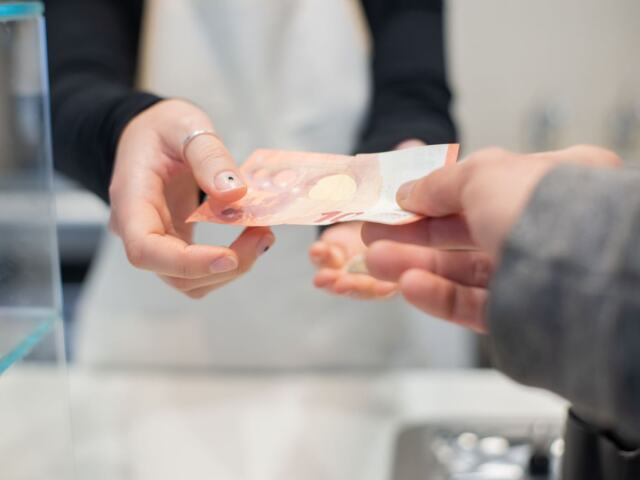
Card payment is where the practical questions arise. Taste of France reports that some card machines now give customers the option to add a tip, sometimes suggesting percentages, and you should not feel obliged to choose one because service compris still applies.
Leaving a few euros in cash after paying by card is also completely normal. Snippets of Paris warns that if you want the tip on the card, you may have to ask for it to be included in the amount, as the machine may not have a button for a percentage.
Connexion France says it depends on the establishment. A common solution is that you state the full amount you wish to pay including the tip, and the employee then takes the tip money out of the till.
Leaving cash on the table as you go is the traditional way, and Connexion France says it should be done in a discreet, not ostentatious way.
Where the money ends up varies. A spokeswoman for the UMIH hospitality industry body told Connexion France that in most establishments, especially smaller ones, tips go straight to the person who is tipped, while others use a common fund shared among staff who deal with the public. The common fund is typically used more in more luxurious establishments.
Tipping habits to avoid
A few habits can land badly even when the intention is kind. Keep these in mind:
- Do not tip before the meal. Connexion France reports that maîtres d’hôte in smart restaurants say some clients try to tip before the meal in the hope of a better table, which may not be appreciated.
- Do not make a show of it. Quietly leave the money when you go.
- Do not import automatic home-country percentages. Snippets of Paris says French servers have gotten used to Americans tipping 20-25%, and may mention tips to get the same, yet tipping is not required and is not a cultural norm in France.
- Do not feel pressured to reward poor service.
Connexion France also reports that tipping is less common and less generous than it was, and is used less by the young than by older generations. If you leave less than you would at home, you are not being rude.
Useful phrases and the idea behind them
A handful of words make the end of the meal smoother. The French word for a tip is un pourboire, according to Taste of France.
- Gardez la monnaie: keep the change.
- L’addition, s’il vous plaît: the bill, please.
The word pourboire literally means to have something to drink. Connexion France says its first recorded use was in a Molière play in the 17th century, when a character in L’Ecole des femmes pays a tip, saying voilà, pour boire.
Taste of France sums up the whole approach neatly: in France, a tip is a thank-you, not part of the bill. If you remember only that, you will manage any restaurant.
Frequently asked questions
Is service included in French restaurant bills?
Show answer
Usually, yes. Snippets of Paris says the words service compris or service inclus on a bill indicate that the service charge is already included, so an extra tip is not necessary.
Should you tip 20% like in the United States?
Show answer
No. Snippets of Paris says French servers are used to Americans tipping 20-25% and may mention tips, but tipping is not required and is not a cultural norm in France.
Can you tip by card in France?
Show answer
Sometimes. Taste of France says some card machines offer a tip option, but you do not have to use it, and leaving a few euros in cash is also completely normal. Whether a machine takes a tip at all varies from place to place.
What does pourboire mean?
Show answer
It is the French word for a tip. Connexion France says it literally means to have something to drink.